
Understanding Elk County Jail Releases
A release from Elk County Jail means the sheriff's legal authority to hold that person has ended or changed. It does not always mean the person walked into the community. The release authority may send someone home on bond, recognize completion of a sentence, place the person under supervision, or transfer custody to the Kansas Department of Corrections, another jail, federal authorities, or immigration officers. The exact discharge time and the authority ordering release are therefore the key local facts.
Elk County does not publish an official current roster or recent-release feed. The durable local source is the sheriff's prisoner calendar required by K.S.A. 19-1904. It records who was committed, when that happened, the cause and authority, a description, and the exact time and authority for discharge. A criminal case file can then explain the order behind the entry. State and federal systems apply only when those agencies held the person.
- Discharge
- The end of a particular agency's authority to confine a person.
- Time served
- A release because the custodial term has been completed or credited.
- Parole
- Community supervision after release from an eligible prison sentence.
- Probation
- A court-ordered community sentence or supervision track, often instead of prison.
Elk County Release Types
The label attached to an Elk County release controls where to verify what happened next. Bond and recognizance releases leave the criminal case open. A dismissal ends the cited charge but may not resolve another case or hold. A transfer ends Elk County custody while another authority continues confinement. Sentence completion ends the local term, though separate supervision or another warrant may still apply.
| Release type | Meaning | Best next record |
|---|---|---|
| Bond or court order | Physical custody ends under court-set terms. | Release order and Court Services record |
| Time served | The local custodial term is complete. | Prisoner calendar and judgment |
| Probation | The court places the person under community terms. | District Court or Community Corrections |
| Parole or postrelease | State prison custody changes to KDOC supervision. | KASPER and Parole Services |
| Transfer or detainer | Elk custody ends, but another agency takes custody. | Release authority and receiving-agency record |
A person may pass through more than one row. For example, a court can resolve the Elk case while a KDOC detainer controls the next movement. Read the sequence, not just the final word “released.”
Fields in Elk County Release Records
The statutory calendar supplies a compact audit trail for Elk County released inmates. It is not the same as a temporary roster tile. Ask for the calendar entry plus any booking detail the jail maintains and the court order tied to the release. Keeping those sources separate makes omissions clear and avoids assuming that the calendar must contain every field used in the jail's internal system.
| Field | What it establishes |
|---|---|
| Name and description | Identity information recorded for the confined person |
| Commitment time | When Elk County custody began |
| Cause and authority | Why and under whose order the person was held |
| Exact discharge time | When the sheriff's custody ended |
| Release authority | The court, agency, or legal basis directing discharge |
| Booking or case number | A link to related jail or court records, if maintained |
| Release type or destination | Community release, supervision, or transfer, if maintained |
The last two rows may come from related systems rather than the minimum statutory calendar. Request them by name. A release timestamp proves when Elk County authority ended. The authority and destination explain whether the person was free, supervised, or continuously detained elsewhere.
Retention depends on the custodian. Elk County publishes no online jail-record retention policy. KDOC follows a different schedule: its inmate file remains intact for three years after sentence expiration, selected documents such as court papers, the photograph, parole certificate, and discharge certificate remain for another 27 years, and some KASPER information is permanent. A historical state record can therefore remain visible long after custody and supervision end. Its presence is not proof of current incarceration.
The official statute page shows the mandatory local calendar fields that should anchor a focused request.
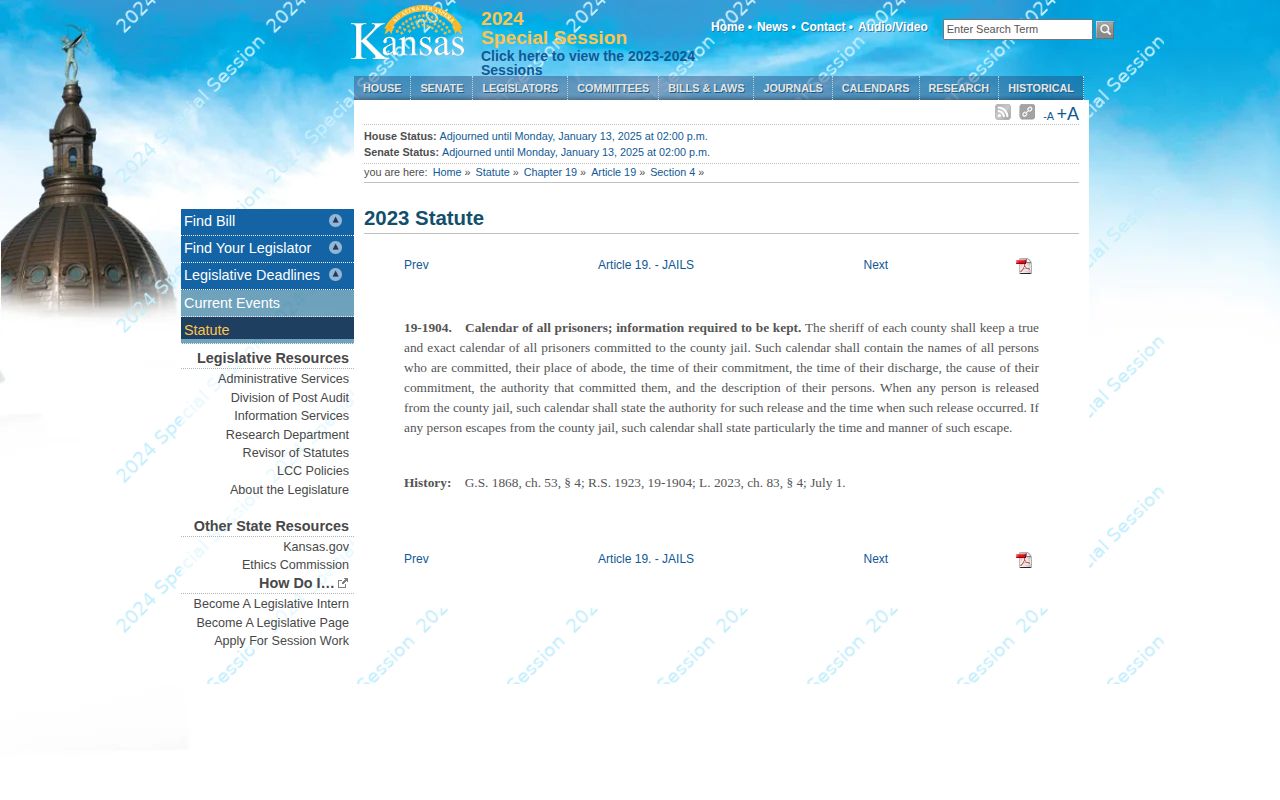
The text separates the exact discharge time from the authority for release, two facts that should be read together.
Request Elk County Discharge Records
Send a focused Kansas Open Records Act request to the Elk County Sheriff's Office, the agency that maintains the jail record. No sheriff-specific online form, fixed fee table, or guaranteed production time was found. Kansas law allows actual costs and advance payment. A prompt initial response may provide the record, ask for clarification, give a fee estimate, cite a lawful restriction, or state the earliest expected availability.
- Identify the person with full name and any known date of birth, booking number, or case number.
- Give a narrow date range and ask for the K.S.A. 19-1904 prisoner-calendar entry, exact discharge time, and release authority.
- List booking detail, release type, destination, and booking photograph as separate items if needed.
- Ask for an electronic native file or PDF, request a fee estimate, and set a cost cap before work begins.
- If material is withheld, ask for the statutory basis and all reasonably separable open portions.
100 N. Cedar St., PO Box 127
Howard, KS 67349
620-374-2108
sheriff@elkcountyks.org
Official office hours were not published.
Sealed, expunged, juvenile, medical, investigative, and security-sensitive material may be restricted. Kansas adult conviction expungement is governed by K.S.A. 21-6614, but a change in one public system does not prove that every lawfully held source has the same record. State the search date and describe only what the public source returned.
Keep a request log with the date sent, recipient, exact scope, fee estimate, response date, redactions, and file received. That chain distinguishes a documentary release record from an informal phone status check. It also makes a later correction possible if a case is sealed or a source updates its public display.
Kansas Law on Elk Release Records
The Kansas Open Records Act, K.S.A. 45-215 et seq., starts from public access but contains mandatory and discretionary exceptions. K.S.A. 45-221 includes limits for criminal-investigation records and other protected material. A custodian relying on an exception should identify the legal basis. Requesting a known calendar entry is different from asking the office to create a new report.
K.S.A. 19-1904 names the exact discharge time and release authority as calendar fields. Those facts are the strongest local substitute for a missing online release feed.
K.S.A. 19-1930 also matters because county jails may hold city, federal, parole, conditional-release, or other detainees until the proper authority orders discharge. This is why the Elk County record must be reconciled with the receiving agency or court. No official sheriff retention schedule was found in the research, so a request should not promise that every historical booking remains online or available.
The Kansas Attorney General's KORA guidance explains the practical request framework. A records custodian may charge lawful actual costs, require advance payment, ask for a clearer scope, or withhold exempt portions. When immediate access is not possible, the response should explain why and give the earliest expected availability. That first response is not always the final production.
Elk County Supervised Bond Releases
District 13 Court Services performs bond supervision. A person released from Elk County Jail on supervised bond is outside the jail but still has a pending case and reporting duties. That status differs from time served, dismissal, probation, or final discharge. The bond order and Court Services record are the proper sources for the conditions.
Roster absence cannot show whether bond was posted, recognizance was granted, or another hold remained. Use the exact discharge authority to locate the court order. Court Services is part of the 13th Judicial District, while Community Corrections handles assigned felony probation and KDOC handles parole or postrelease supervision. Those offices should not be treated as one agency.
Elk Jail Transfers After Release
Official September 2024 county minutes show that Elk County Jail holds inmates for outside agencies and set a $55-per-day interagency rate in Resolution 2024-12. That rate is an agency confinement term, not a charge assessed to an inmate. More importantly, the arrangement shows why leaving the Howard jail can mean a return or transfer to the responsible authority.
The prisoner calendar's release-authority field resolves that ambiguity. If KDOC, another county, the U.S. Marshals Service, or ICE receives the person, Elk County custody has ended but detention may continue. Check the receiving system before describing the event as community release.
Find Released Elk County Inmates
No single database covers every Elk County release. Begin with the system that actually held the person. Use exact names, dates, and identifiers, and preserve the time checked because custody data changes.
- Ask the sheriff for the named K.S.A. 19-1904 calendar entry. For a recent time window, define the exact beginning and end in Central Time.
- Search Kansas Adult Supervised Population Electronic Repository, or KASPER, if the person may have entered KDOC custody or supervision.
- Search the Kansas courts Smart Search by name, then obtain the Elk case order or disposition using the case number.
- Check VINELink for a participating agency's person-specific status and alerts, while treating a transfer alert separately from community release.
- Use the BOP or ICE locator only for federal or immigration custody, then request the originating record when the public result is unclear.
A released person normally drops off a live custody roster. A missing result is not release proof; use the discharge record, court order, or receiving-agency status.
For a projected state date, compare the KASPER estimate with later movements and status. An anticipated date alone does not establish that release occurred.
KDOC Search for Elk Releases
KASPER, maintained by the Kansas Department of Corrections, includes current and former adult KDOC populations from 1980 forward. It may show prison, parole, postrelease, conditional release, and discharged records. It does not cover a county-only booking. Accept the disclaimer, search by name or KDOC number, and compare identifiers before opening a detail record.
| Search field | Use |
|---|---|
| KDOC number | Best match when known |
| First and last name | Basic person search |
| Birth date or age | Helps separate similar names |
| Gender and race | Optional narrowing fields |
| Conviction county | Can narrow to Elk, but is not a home-county field |
| Photos or thumbnails | Visual comparison, not proof of release |
The official KASPER disclaimer and search entry shows its working-day update limits and scope.
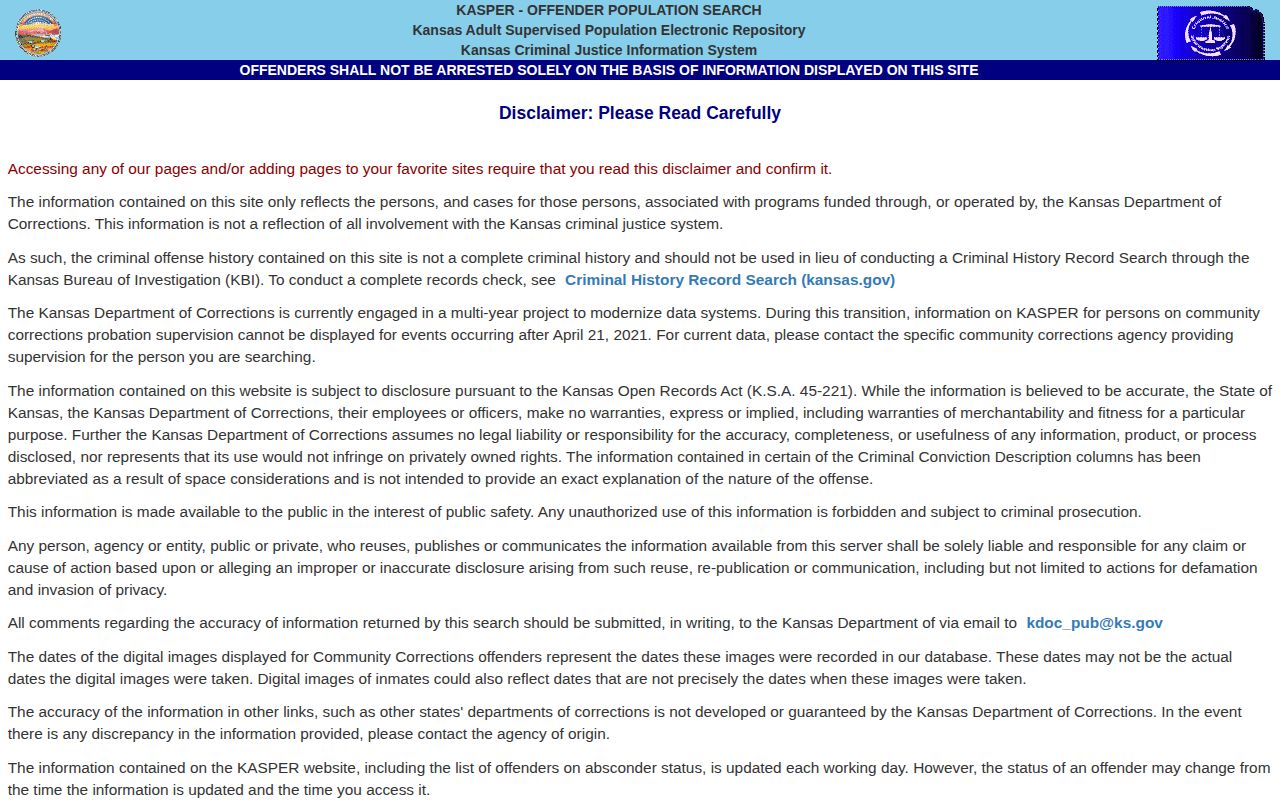
Read status, movements, supervision office, and dates together. “Anticipated release date” is prospective. A released, discharged, or community-supervision status plus movement history provides stronger evidence of what occurred.
KASPER updates on working days, so it is not a jail-door log. It also warns that modern Community Corrections probation data after April 21, 2021 may not display during system modernization. Contact the assigned Community Corrections agency when that gap matters. For an unclear sentence calculation, KDOC's Sentence Computation Unit is the correct office rather than the county jail.
Elk County Recent Release Searches
As of July 18, 2026, the official Elk County Sheriff page offered no roster, 24-hour release list, 72-hour list, booking gallery, request form, or sheriff app. The absence of a web feed does not mean no release record exists. Define an exact Central Time interval and ask for all calendar entries whose discharge timestamp falls within it.
The sheriff page itself displays the official contact route and a KASPER link, while its lack of a release tool is visible.
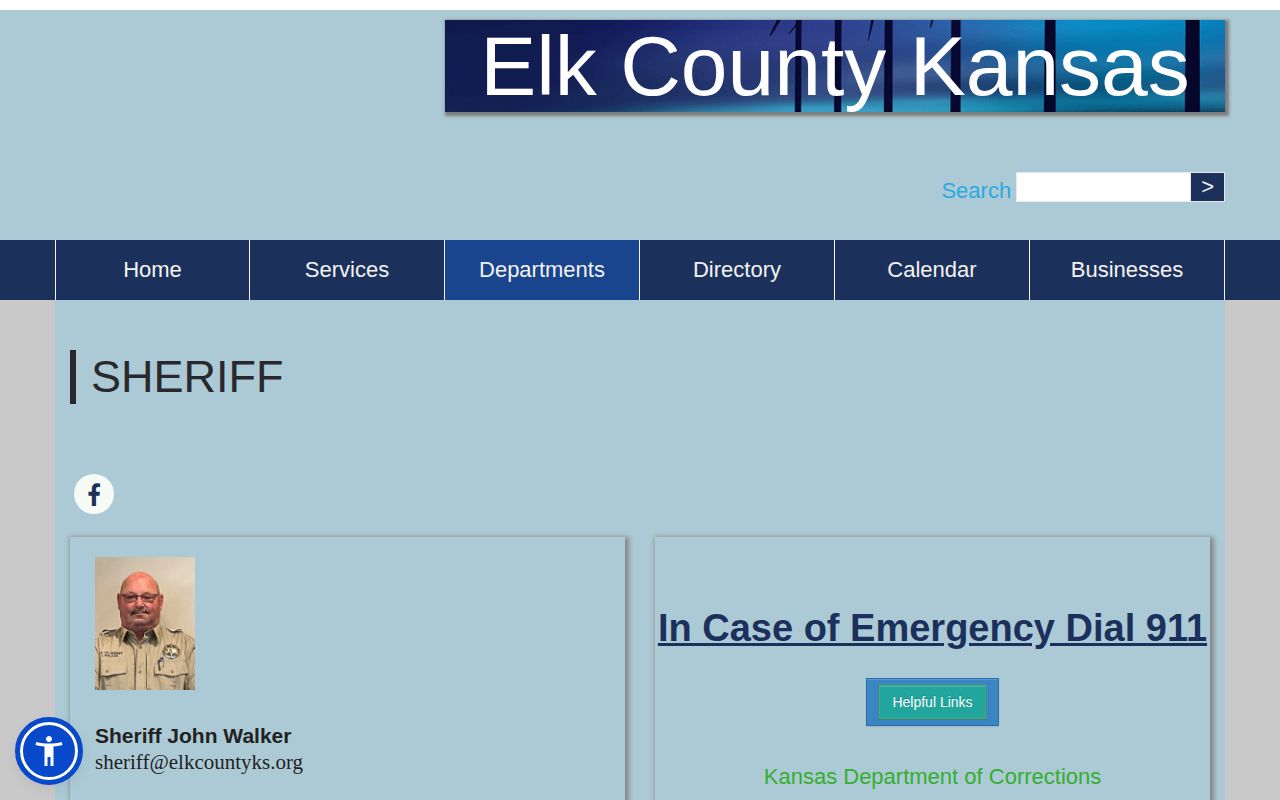
Use that contact information for the county calendar. KASPER applies only when KDOC custody or supervision is part of the sequence.
A three-day interval can catch events around a weekend or holiday, but no official source establishes Elk County's posting lag, release hours, door, or weekend procedure. Third-party pages may cache or infer status with an unknown schedule. Treat them only as leads and verify any person through the sheriff's record.
Elk County Supervision After Release
Supervision depends on the sentence and agency. KDOC Parole Services covers parole, conditional release, and postrelease supervision through the El Dorado Parole Office for Butler, Elk, and Greenwood counties. KASPER may display the current office and supervision status. Court probation and supervised bond are handled through District 13 Court Services, while felony probation may be assigned to 13th Judicial District Community Corrections.
An absconder is a supervised person reported as failing to remain in contact. KASPER has a parole-absconder search, but an absence from it does not prove compliance or discharge. Verify the individual record and contact the listed office. The full agency split is detailed on the Elk County probation and parole page.
The Prisoner Review Board handles discretionary parole decisions for eligible indeterminate sentences. Modern determinate sentences generally move to mandatory postrelease supervision after the prison portion. A prospective hearing list is not a release list, and “parole eligible” is not an actual release event. Later KASPER movement and status or the relevant certificate provides better confirmation.
Elk Release Alerts and Federal Records
Kansas VINELink can provide person-specific custody status and event notifications when the holding agency participates and sends data. Search by full name or offender ID, compare the displayed agency and identifiers, and register only for events offered in the live interface. Phone, text, email, account, or app confirmation steps can differ. A transfer event is not the same as release to the community.
Federal Bureau of Prisons cases use the BOP Inmate Locator. A result may show register number, age, race, sex, location, and release date. “RELEASED” means no longer in BOP custody, though supervision or another agency's custody may follow. ICE's locator covers some people currently in immigration custody. A county release to ICE is a transfer, and a missing ICE result can have many causes. Pretrial federal status may require the federal court, detention facility, or U.S. Marshals district.
The ICE Online Detainee Locator searches with an A-number and country of birth or with biographical fields. Spelling, transfer, recent booking, age, privacy rules, removal, or database scope may explain a missing result. Contact ICE Enforcement and Removal Operations or the detention facility when the result is unclear. No federal prison or dedicated ICE facility was identified inside Elk County, so these are exception routes, not substitutes for the sheriff.
The official BOP search page illustrates the federal fields used to distinguish its records from Elk County jail records.
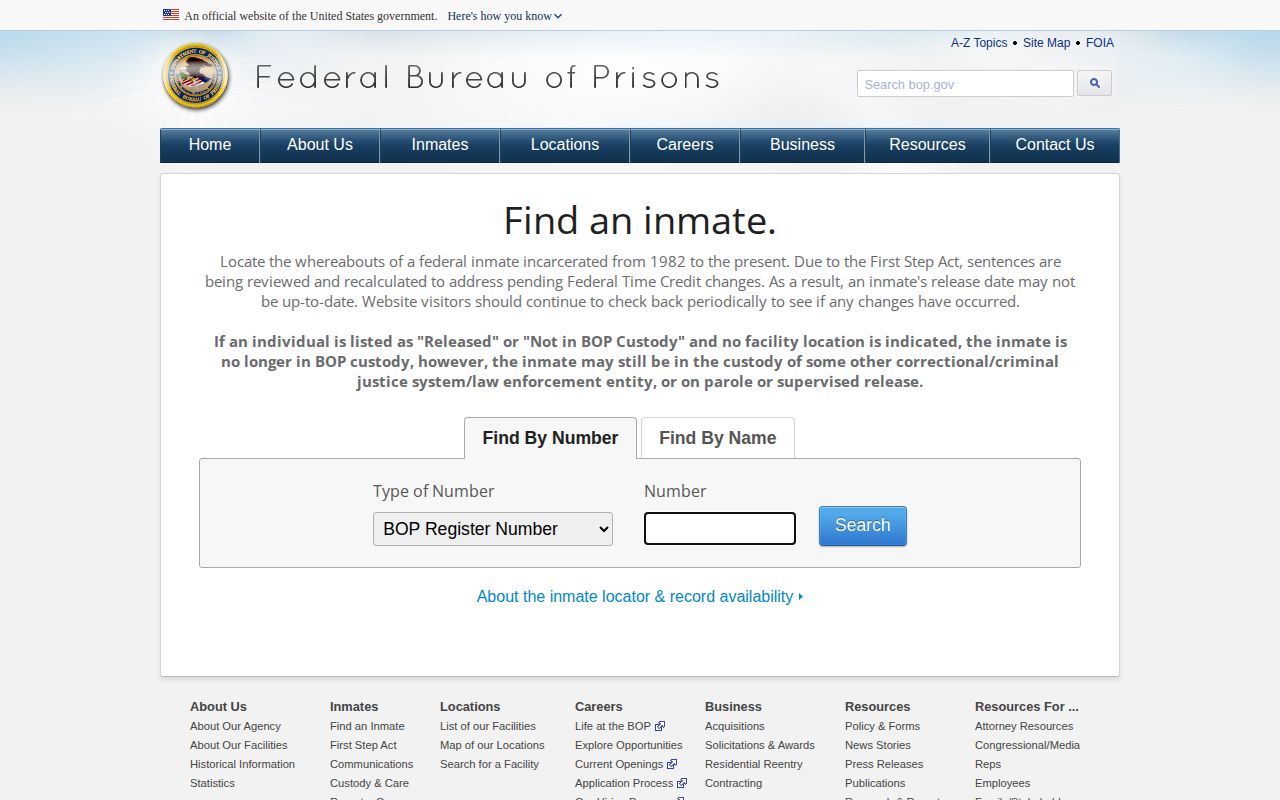
Never merge the county and federal timelines without checking which sovereign held the person at each point.
Where Elk Release Status Appears
Choose the source by custody type and the question being asked. Each row below has a different legal scope.
| Source | Still in custody | After release |
|---|---|---|
| Elk County Jail | Call the sheriff; no official roster was found | Request the prisoner calendar and release authority |
| KASPER | KDOC location and status | Released, supervised, or discharged status and movements |
| Kansas courts | Orders may show detention or bond | Disposition, sentence, and release order |
| VINELink | Participant-reported custody status | Reported release event or alert, subject to lag |
| BOP | Federal location | Release date and “RELEASED” location |
| ICE | Some current immigration custody | Missing results require direct confirmation |
The Kansas Bureau of Investigation registry serves a special statutory purpose for people required to register. It is not a general release database. The agency warns that data can be incomplete or wrong and identifies fingerprint comparison as the conclusive identity method. Its frequent update cycle does not turn an address or registry entry into proof of a jail discharge. Likewise, a mugshot or old booking page cannot establish present custody.
The official registry entry displays its scope and cautions beside the search route.
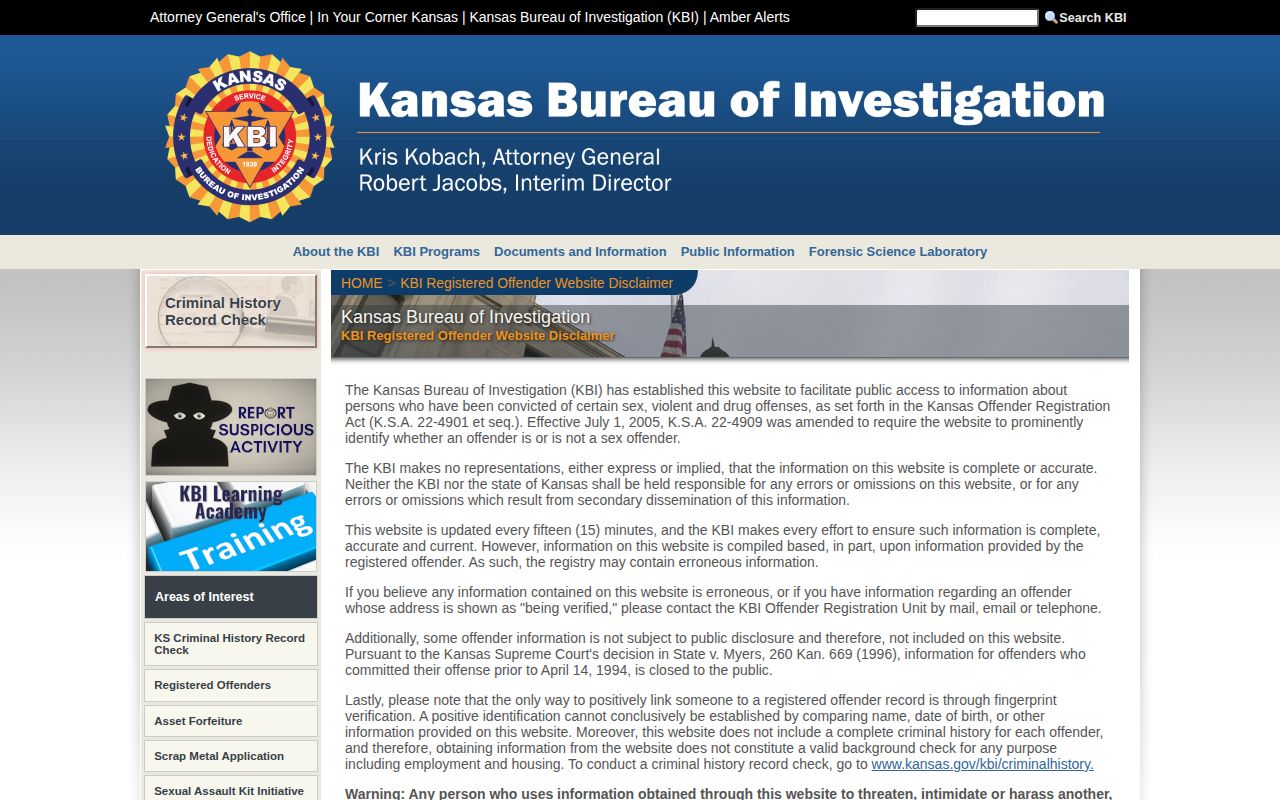
Use a registry result only for its defined statutory purpose and verify identity and custody through the originating records.
Elk Release Orders in Court Files
Kansas District Court Public Access Portal Smart Search can locate a case by name, though restricted, sealed, and expunged matters may not appear. The Elk County court page provides a local offline route: open files can be reviewed by appointment with the case number, a public terminal is available, and written information requests have a stated three-business-day response path.
The statewide Smart Search landing page is the first index for an Elk criminal case.
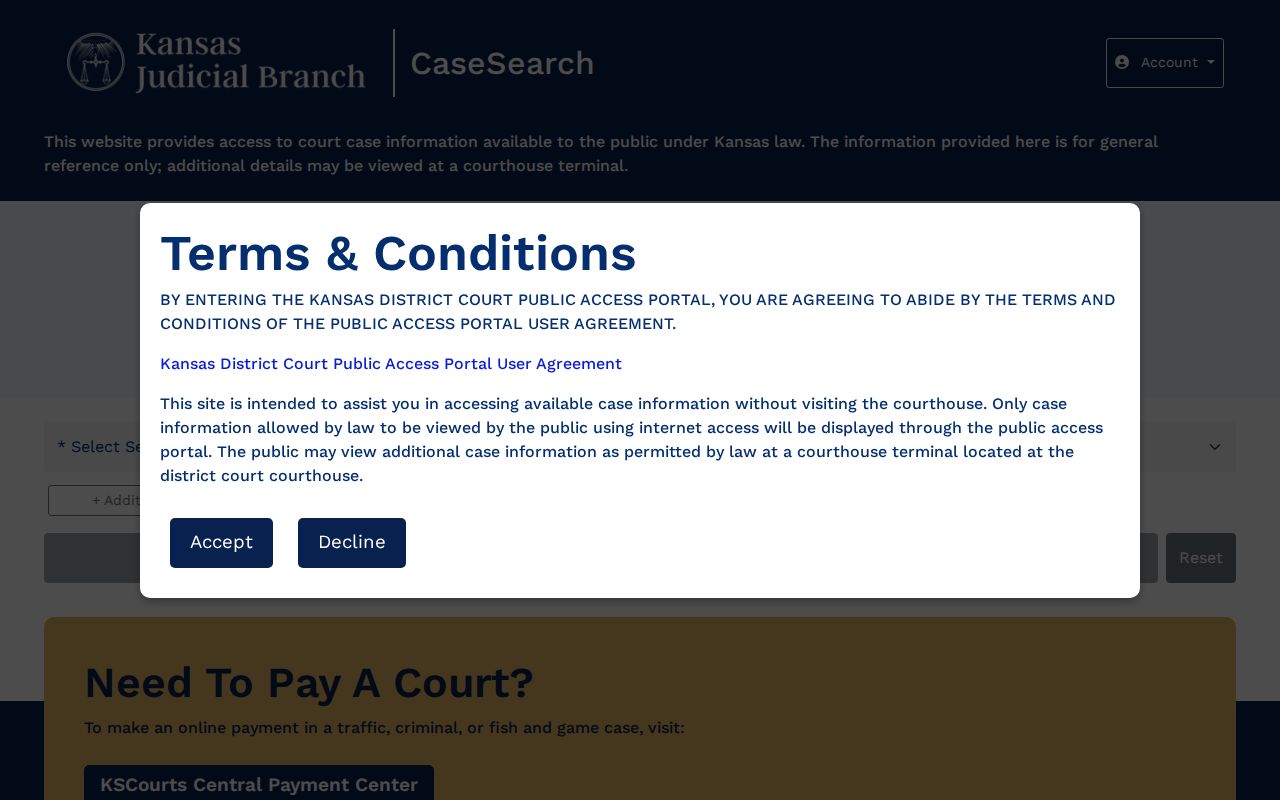
A matching docket entry should lead to the signed order or clerk-held file, not stand alone as a guess about release.
The 13th Judicial District Elk County page publishes courthouse contacts, file-access times, and copy fees. Email copies cost less when staff research remains under an hour, while other research, certification, and media charges differ. These are court-copy fees, not sheriff record fees. Use the court order to explain bond, dismissal, sentencing, remand, or other authority behind the sheriff's exact discharge entry.
The official local page shows how Elk County file access and fees are presented.
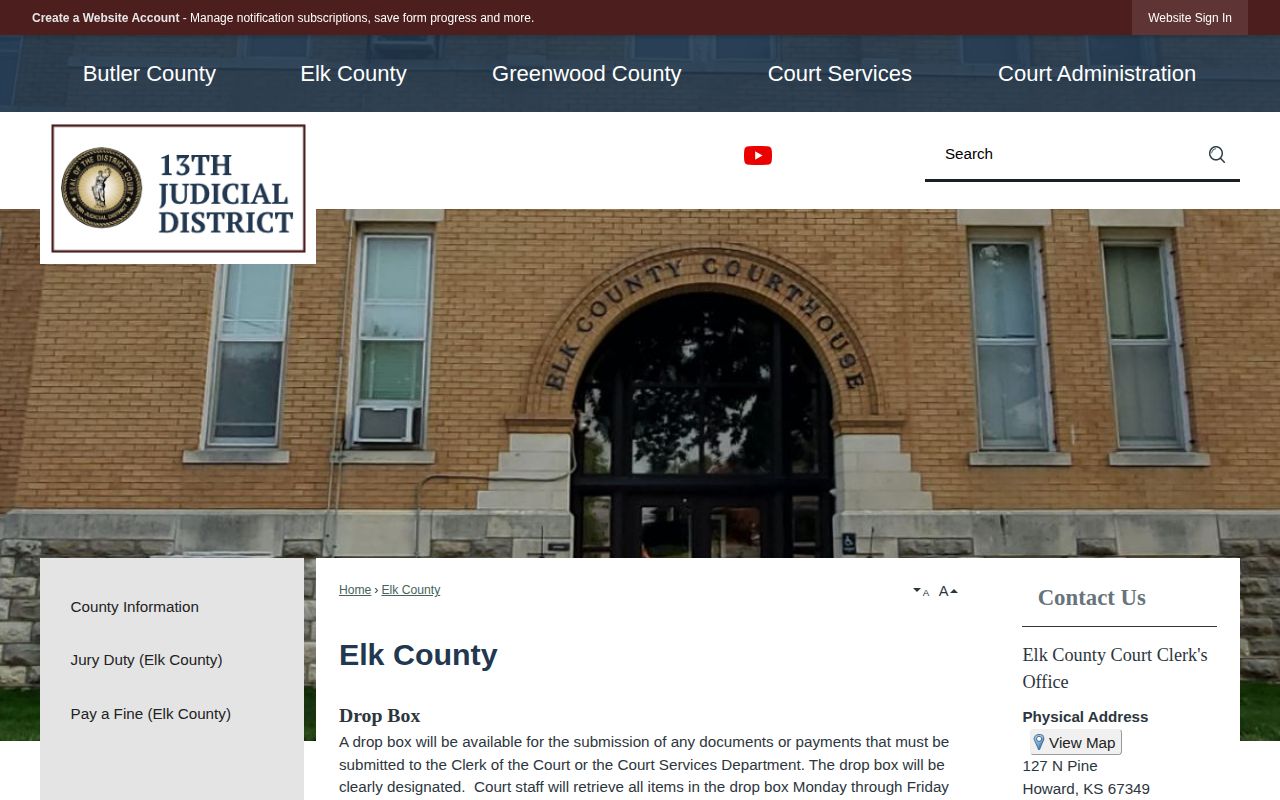
A court response and a jail record should be logged separately so each claim remains traceable to its source.
Getting Home After Elk Release
The City of Howard identifies Elk County Council on Aging as working with General Public Transportation. The vans use a set schedule, have no age requirement, and may serve appointments and other trips. Call 620-647-6335 in advance to ask about current availability.
This is transportation planning help, not a promised jail pickup. No official source states which exit is used, when property is returned, whether family may wait at the jail, or whether a van coordinates with discharge time. Confirm release logistics separately with the sheriff and make any travel plan with enough time for processing changes.
Elk County Detention Facility
Elk County Jail is the only detention facility in the research Facility Map. The Elk County Sheriff's Office operates it in Howard. A person may leave for the community under a court order or completed sentence, move to probation or state supervision, enter KDOC custody, or return to another agency that arranged confinement.
The destination must come from the release authority, not the building's location. For an Elk booking photo, ask the sheriff. A KASPER image is a KDOC identification photo and may not be the county booking image.
Search Elk County Release Records
Match names with a case, booking, KDOC, or federal identifier, then verify the release through the agency that created the record.
Sponsored Results