
Elk County VINELink Coverage
Kansas VINE is the state custody-information and notification channel for agencies that participate and send records. It is designed for a specific-person check. It is not a historical list of everyone released in Elk County. The Elk County Sheriff's Office website does not publish a statement confirming its VINE participation, so select Kansas in the live service and look for Elk County Jail among the agencies offered. If it is absent, call the sheriff rather than treating the missing agency or person as proof of release.
Kansas VINE and VINELink can report the status, location, identifier, and event supplied by a participant. A state prison record may also be found through the Kansas Department of Corrections system, but KASPER remains the authoritative public route for KDOC custody and supervision. Federal Bureau of Prisons records are outside VINELink. Immigration custody also uses a separate federal locator. The system that last held the person determines the right search path.
Search Elk County VINELink Records
Start with the official Kansas VINELink search. A full legal name or offender ID gives the best chance of isolating the right person. Name-only results need care because two people can share similar names. Compare every identifier the result provides before relying on the record. A county booking identifier, KDOC number, birth information, agency, and facility are more useful than a name by itself.
- Open Kansas in VINELink and choose the custody category or agency shown by the current interface.
- Enter the full name or offender ID. Use agency filters, including Elk County Jail, only when the service offers them.
- Review all possible matches. Compare identifiers and the reporting agency before opening a record.
- Open the matched record and note the status, location, offender ID, latest event, and event date exactly as displayed.
- Save the reported event, then verify a county release with the sheriff or a state status with KASPER.
A released result supports the fact that a participating agency sent a custody-change event. It may not explain the legal authority or destination. A transfer can also generate an event while the person remains confined. For a named-person search that must reconcile county, court, state, and federal sources, the Elk County released-inmate search sets out the full custody chain.
If no match appears, check spelling, aliases, and the identifier before changing systems. Then ask whether the person ever entered the agency being searched. A county-only detainee may have no KDOC number, while a state prisoner may no longer be tied to the county jail. Search failure should narrow the next question, not settle the person's status. Call the Elk County sheriff for local custody, use KASPER for a Kansas sentence, and use the appropriate federal locator only when federal custody is known.
Elk County VINELink Release Fields
Read the result as a set of linked facts. No one field should carry the whole conclusion. Status describes what the participant currently reports. Location identifies the reporting facility or agency. The offender ID helps separate people. Event and date show what changed and when the system recorded it. Exact labels vary with the agency and the current VINELink interface.
| Field | What it can establish |
|---|---|
| Custody status | The participant's reported state, such as in custody or released, at the displayed update. |
| Facility or agency | Which participant supplied the record and where the person was last reported. |
| Offender identifier | A key for distinguishing similar names and confirming the matched record. |
| Custody event | The kind of change reported, which may include release or transfer. |
| Event date | The date tied to that event, not necessarily the exact statutory discharge time. |
For Elk County Jail, the stronger local proof is the sheriff's prisoner calendar required by K.S.A. 19-1904. That record should contain the exact discharge time and authority for release. For a Kansas state prisoner, KASPER status, movements, and supervision office should be read together. A VINELink event can tell someone when to ask, while the originating record answers what legally happened.
Write down the label exactly. “Released,” “transferred,” and “not in custody” can reflect different events, and a date may refer to the latest status update rather than a door time. Do not convert a broad label into a more specific claim. If the field lacks a destination, ask the reporting agency where custody went next. That small check matters in Elk County because a person housed locally may remain responsible to another agency after leaving the jail.
Set Elk County Release Alerts
Notification starts from a correctly matched person record. Choose the event or events offered by the live system, such as release, transfer, or another custody change. Then select an available delivery channel. VINELink may offer phone, text, email, an account, or an app route. Availability can vary. Give only the contact information the chosen channel requests and complete its verification process.
- Confirm the person, identifier, and reporting agency before selecting notification.
- Choose the custody event that matters. A release event and a transfer event do not mean the same thing.
- Select an offered phone, text, email, account, or app delivery method.
- Complete contact verification. Follow a PIN prompt only if the selected phone workflow actually displays one.
- Keep the confirmation and later alert, including its agency, event, and reported time.
Traditional VINE telephone calls may use a PIN to confirm receipt and stop repeat calls. A web or app workflow may instead use an account, emailed link, or one-time code. There is no sound basis for promising one universal PIN method. Follow the screen in use. If a delivery channel changes, update the registration rather than assuming an old alert remains active.
Registering more than one offered channel can reduce the chance that a missed call or filtered message hides a prompt event. Still, registration is not a guarantee. Keep the sheriff's number and the matched agency name with the alert details. If personal safety or a court matter depends on the timing, contact the responsible agency directly and follow any separate plan provided by an advocate or court official.
Kansas VINELink Search Screen
The official Kansas VINELink landing page is the proper entry point for a current person search and notification options.
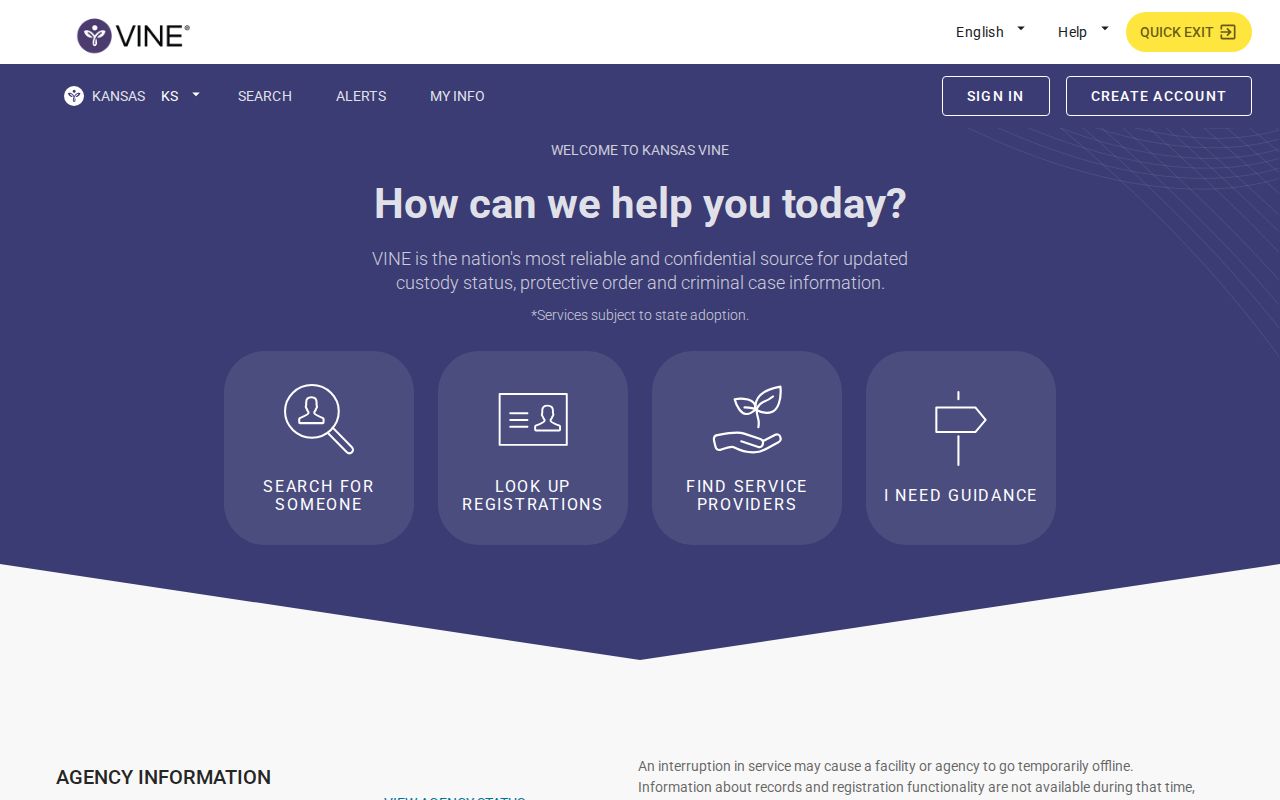
The captured screen anchors the search to Kansas, but live agency choices and registration steps control. Check the current fields instead of assuming that an older screen still matches the service.
Verify Elk County Release Events
Elk County does not publish an official online jail roster or recent-release feed. That makes direct verification especially important. For a local jail event, contact the Elk County Sheriff's Office at 100 N. Cedar St., PO Box 127, Howard, KS 67349, or call 620-374-2108. The cited sheriff page does not publish office hours. Ask for the named prisoner's calendar entry, exact discharge time, and authority for release. A court order or case docket can then show whether the event involved bond, dismissal, probation, sentence completion, or another action.
A disappearance from VINELink is not a release record. Nor is a missing person result. The agency may not participate, identifying data may differ, or data delivery may lag. When a result says released, ask whether it means release to the community or release to another authority. Elk County can house people for outside agencies, so departure from the building can be a transfer back to the responsible custodian.
The related criminal case can explain a community event. Kansas Smart Search may show bond, dismissal, disposition, sentence, probation, revocation, or commitment entries. A docket label can be terse, so obtain the signed order when its meaning is unclear. If the sheriff calendar says release to KDOC, follow the person into KASPER. If it names an outside authority, contact that custodian. These links in the custody chain prevent a broad VINE status from being read beyond what it says.
Separate Elk County Custody Systems
Use the reporting system that matches the legal custody. An Elk County jail-only record belongs with the sheriff and District Court. A person transferred to KDOC may appear in KASPER after state intake. A state prisoner released on parole, conditional release, or postrelease supervision remains under KDOC community supervision even though institutional custody ended. A discharged KASPER status is a later and stronger milestone because the state sentence obligation has ended.
- Release
- A reported exit from one custody, which may be to the community or another authority.
- Transfer
- A move between custodians or facilities while physical custody continues.
- Postrelease supervision
- The community portion that follows the prison part of many Kansas determinate sentences.
- Discharge
- The end of the KDOC sentence obligation, not merely departure from prison.
The Bureau of Prisons locator is the correct route for a federal sentence. ICE uses its own detainee locator. Neither is replaced by a Kansas VINELink search. In all systems, an alert should be saved with the name, identifier, agency, event, and access date. If sources disagree, contact the source that created the disputed event and state the conflict until it is resolved.
Timing explains many conflicts. A court may sign a bond order before the jail completes release processing. VINELink may send a transfer event before the receiving agency posts intake. KASPER generally updates on working days, while Elk County publishes no online cadence. Record both the event time and the time each source was checked. When two systems describe different custodians, both can be accurate even though their labels appear to disagree.
Keep the inquiry focused on the named event. Ask the sheriff for the calendar line and release authority, the clerk for the signed order, or KDOC for the state computation and status. A precise request is easier to verify than a broad request for every record. It also preserves the difference between notification, custody movement, community supervision, and final sentence discharge.